Applicant tracking system
ATS software with the interview built in.
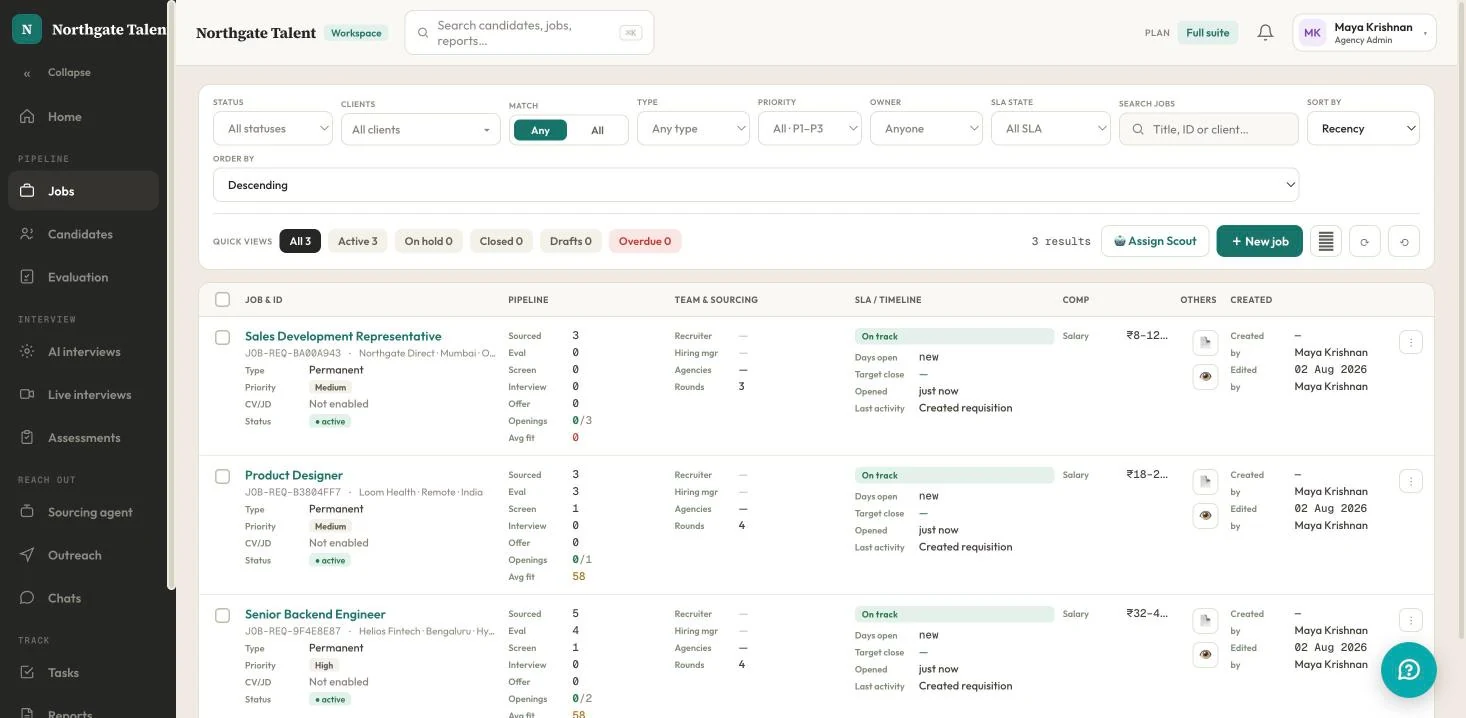
Applications, screening, interviews, scorecards and the signed offer on one record — instead of an applicant tracking system plus four tools that email each other.
The basics
What applicant tracking software actually does.
An ATS is the system of record for hiring. Every application lands in one place, every candidate has a stage, every decision has an owner and a date. That is the whole job, and it is worth doing because the alternative — a shared spreadsheet and four inboxes — fails quietly rather than loudly. Nobody notices the candidate who was never replied to.
The part that has aged badly is what happens next. Traditional ATS software tracks that an interview occurred; it does not hold what was said, what was scored, or why one person was preferred to another. So the assessment lives in a video tool, the technical screen in a coding tool, the scorecards in a form, and the reasoning in somebody's memory.
The difference
One record, application to signature.
The evidence lives with the candidate
Resume, screening score, interview transcript, coding submission, panel scorecards and the offer are one record. When someone asks in March why you hired this person in January, the answer is on the page rather than in four systems.
Screening happens on the way in
Applications are parsed and scored against the role as they arrive, so the pile is ordered before anyone opens it. Nobody is rejected automatically — the ranking decides your reading order, not the outcome.
Interviews do not need scheduling
The first round is asynchronous: one link, taken whenever the candidate is free, transcribed and scored against your rubric. The calendar only gets involved once you have decided someone is worth a person's time.
The stage data is real
Because transitions are recorded as they happen rather than reconstructed, time to hire is measured rather than estimated, and the stage that is actually losing people is visible instead of inferred.
It ends where hiring ends
Offer approval, generation and e-signature are part of the same flow. The last mile is where a good process usually reverts to email attachments and a scanner.
What is in the ATS software solution
Not modules to be quoted for separately. This is what the product is, and most of it is in the free plan.
| Module | What it does | Free plan |
|---|---|---|
| Jobs and approvals | Requisitions, approval chains, published job pages | 1 job |
| Candidates | Records, resume parsing, deduplication, bulk import | Unlimited |
| Pipeline | Stages, transitions, ownership, per-stage conversion | Included |
| Screening | Applicants scored against the role, with evidence | Included |
| AI interviews | Async video first round, transcribed and scored | 20 / month |
| Live panels | Browser rooms, guests without accounts or seats | Included |
| Coding tasks | Real code against your test suite, in-tab | 5 runtimes |
| Assessments | Standalone tests with scored attempt reports | Included |
| Scorecards | Structured debriefs, merged across interviewers | Included |
| Offers | Approval, generation and e-signature | Included |
| Analytics | Time to hire, cost, accept rate, source, funnel | Included |
| API and webhooks | REST for everything the UI does, signed events | Included |
Moving over
Migrating from another ATS.
Step 01
Start with one live role
Not five years of history. Run a role you are actually hiring for end to end, in parallel with whatever you use now, and judge it on that.
Step 02
Import what you need
Candidates and jobs come in by CSV or API, resumes parsed on the way. Historical stage data follows where your current system exports it.
Step 03
Or keep both
Push candidates in through the API, run screening and interviews here, and write the scored report back to the ATS you are keeping. No migration required.
Also included
The parts teams ask about on the second call.
Roles and permissions
Recruiters, hiring managers, interviewers and admins see different things. Guest interviewers join a panel without an account and without consuming a seat.
White-label for agencies
Your logo, palette, domain and email sender across every candidate and client touchpoint, with one workspace per client.
REST API and webhooks
Everything the interface does, available programmatically, with signed and replayable events. OpenAPI 3.1.
Tenant isolation
Separation enforced in the database rather than by application filtering, so a query bug cannot cross an organisation boundary.
Published pricing
One job free forever, then seats plus metered interviews. You can evaluate the product before speaking to anyone.
Export, always
Candidates, scores, transcripts and analytics export in full. Data you cannot get out is data you do not really own.
Questions about ATS software
- What is ATS software?
- An applicant tracking system is the record of who applied to what, where each person is in the process, and what was decided. At minimum it stores applications and moves them through stages. In practice the value is in what it saves you from: chasing status in a spreadsheet, losing a candidate in an inbox, and having no answer when someone asks why a hire took eleven weeks.
- How is this different from a traditional ATS?
- Most applicant tracking systems track the process and leave the assessment to other tools — a video interview product, a coding test product, a scheduling product — with integrations between them. Here the interview, the coding task, the scorecard and the offer are part of the same record, so the evidence sits with the candidate rather than in four exports.
- Which ATS software solution suits a small team?
- One you can run without an administrator. The honest test is whether you can post a role and take a candidate to offer without a training session or an implementation call — if you cannot, the licence cost is the smaller number. Our free plan exists so you can find that out on a real role before paying anything.
- Can I keep my existing ATS?
- Yes, and plenty of teams do. The API and webhooks let you push candidates in, run the interview and scoring, and pull the scored report back into the system you already have. That is a common first step and it does not require migrating anything.
- How does migration work?
- Candidates and jobs import from CSV or through the API, resumes are parsed on the way in, and historical stage data comes across where your current system exports it. We would rather you started with one live role than moved five years of history on day one — the history is easier to backfill later than a bad first month is to undo.
- Is candidate data isolated between clients?
- Yes. Each organisation's data is separated at the database level rather than by application-layer filtering, and agencies get one workspace per client. The details are on the security page, in specifics rather than badges.
- What does it cost?
- One job is free forever. Beyond that it is $49 per seat per month plus $6 per completed AI interview, so a quiet month costs you a quiet month. Panel rooms, coding tasks, assessments, offers and guests are not metered.
Keep reading
Get started
Run one role through it.
One job is free forever. Post it, screen it, interview it and decide afterwards whether it is worth paying for.
No card. 1 job free forever. Cancel by closing the tab.